Data residency vs inference residency comes down to storage versus processing. Data residency controls where your AI data is stored at rest: files, chat history, search indexes and logs. Inference residency controls where the model processes your prompts and generates responses. A vendor can store your data in one country and still run inference in another, so AI compliance requires you to verify both.
Key takeaways
- Storage location and processing location are separate controls. Many AI products offer the first without the second.
- Every AI request sends your data through several systems: retrieval, the model, safety monitoring, logs and connectors. Each one has its own location.
- Data protection laws such as the UAE PDPL regulate transfers of personal data, and sending a prompt to a model abroad can count as a transfer.
- In-region inference is still limited. As of September 2026, few major model providers publish an in-region inference option for the UAE.
- Ask vendors where each data type is stored and processed, in writing, per feature.
What Is Data Residency?
Data residency is a commitment that your data is stored at rest in a named geography, such as the UAE, the EU or the US. It covers where the vendor keeps your data on disk, not where that data travels while it is being used.
For an AI assistant, data at rest typically includes:
- Conversations and chat history
- Uploaded files and generated outputs
- Search indexes and vector embeddings built from your documents
- Custom assistants, agents and their instructions
- Stored memory and saved sessions
Vendors define data residency in their own terms, and the scope differs by product. OpenAI, for example, lists conversations, files, custom GPTs, Code Interpreter artifacts and ChatGPT Memory as covered by its data residency. It also says workspace metadata, billing data, authentication and external integrations may be processed globally (OpenAI).
The practical rule: data residency tells you where data sits. It does not tell you where data goes when the model reads it.
What Is Inference Residency?
Inference residency is a commitment that the model runs inside a named geography when it processes your request. Inference is the step where the model receives your prompt and retrieved context and generates the response.
Inference residency matters because a prompt is rarely just a question. In an enterprise AI assistant, the prompt sent to the model usually contains:
- The user's question
- Passages retrieved from internal documents, emails, tickets or chat messages
- System instructions and conversation history
- Tool results, such as a CRM record or a calendar entry
All of that content leaves storage and reaches the model's compute. If the model runs in another country, that content crosses the border for the duration of the request, even if nothing is stored there permanently.
Vendors use different names for this control: inference residency (OpenAI), inference geo (Anthropic), Data Zone or regional deployments (Microsoft Azure), and geographic inference profiles (Amazon Bedrock). Each one limits where prompts and responses are processed, with different boundaries.
Data Residency vs Inference Residency: The Difference
The difference is storage versus processing: data residency fixes where data rests, and inference residency fixes where the model computes on it.
| Dimension | Data Residency | Inference Residency |
|---|---|---|
| What it controls | Where data is stored at rest | Where prompts and responses are processed by the model |
| Data covered | Chat history, files, indexes, embeddings, saved agents | Prompts, retrieved context, tool results, generated output |
| Duration of exposure | Permanent, for as long as data is retained | Temporary, for each request, but repeated on every request |
| Typical risk if missing | Data stored in a foreign jurisdiction | Personal or confidential data transferred abroad on every query |
| How vendors offer it | Region selected at workspace or project creation | Per-request parameter, deployment type or regional endpoint |
| Common trade-offs | Often fixed at setup; may not be changeable later | Fewer models, fewer features or higher prices in some regions |
| What to ask | "Where is each data type stored?" | "Where does inference run for each model and feature?" |
The two are independent. A vendor can offer UAE data residency with global inference, or in-region inference with storage elsewhere. Anthropic's API shows the split clearly: inference geo and workspace geo are separate settings, and workspace geo cannot be changed after the workspace is created (Anthropic).
Where Your Data Goes in a Single AI Request
A single question to an enterprise AI assistant moves data through several systems, and each system has its own storage or processing location. The diagram below traces that path. Only the model step falls under inference residency; the index, logs and chat history fall under data residency; connectors and parts of monitoring can sit outside both.
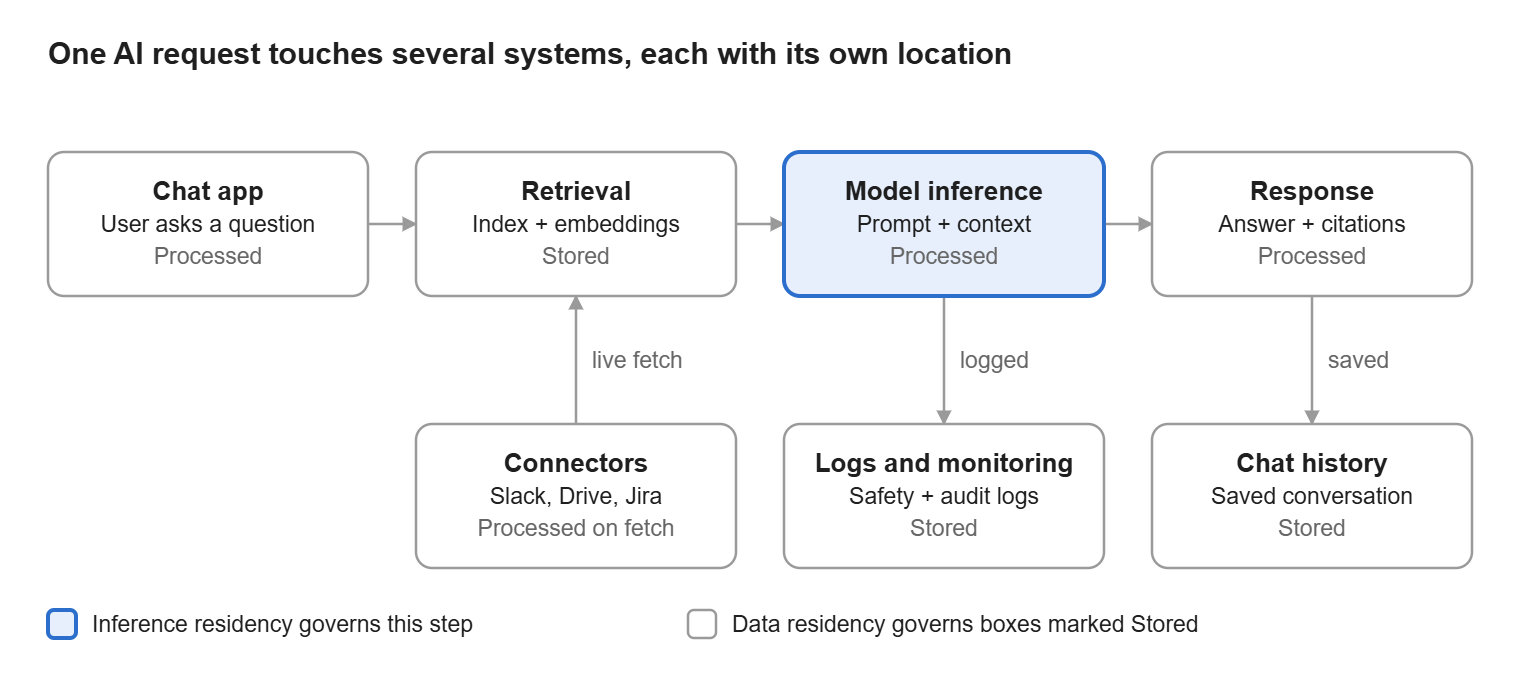
- Chat app. The user's question arrives at the vendor's application layer, which handles authentication and session data. Authentication is often processed globally.
- Connectors. The assistant fetches live content from tools such as Slack, Google Drive or Jira. This content passes through the vendor's integration layer, which may run outside the residency boundary.
- Retrieval. The system searches an index of your documents. The index and its vector embeddings are derived copies of your data and are stored at rest.
- Model inference. The question, the retrieved passages and the instructions go to the model. This is the step inference residency controls.
- Logs and monitoring. Vendors log requests for safety, abuse monitoring and debugging. Log retention and location are set by separate terms.
- Response and chat history. The answer returns to the user and is saved as conversation history, which falls under data residency.
Illustrative Example
An employee in Dubai asks: "What did the client agree to in last week's renewal call?" The assistant retrieves the call notes from Google Drive and a Slack thread with the client's name and contract value. Even with UAE data residency, that personal and commercial data reaches the model's compute on every request. If inference runs in the US or the EU, the data crosses the border each time someone asks.
Why Storage Location Isn't Enough for Compliance
Data protection laws regulate the transfer of personal data, not only its storage. Sending a prompt that contains personal data to a model in another country can be a cross-border transfer, even when nothing is stored there.
UAE mainland (PDPL). Articles 22 and 23 of the UAE Personal Data Protection Law (Federal Decree-Law No. 45 of 2021) allow personal data to leave the UAE when the destination offers adequate protection, or under alternatives such as contractual safeguards, the data subject's consent, or contract necessity. The implementing details, including an adequacy list and approved contract templates, are still unconfirmed (ABS Partners; law text).
Free zones (DIFC and ADGM). The Dubai International Financial Centre and Abu Dhabi Global Market run their own GDPR-style data protection regimes. A transfer from the UAE mainland into DIFC or ADGM is treated as a cross-border transfer in its own right (ABS Partners). "In the UAE" is therefore not always one jurisdiction.
Sector regulators. Banking and health add stricter layers. The Central Bank of the UAE's February 2026 AI guidance states that licensed financial institutions stay responsible for AI outcomes even when functions are outsourced (Pinsent Masons). Health data is subject to in-country localisation requirements, so health AI cannot route records through an offshore model (Groovy Web).
The consequence for AI buyers: a data residency badge answers the storage question only. The transfer question depends on where inference, connectors, logs and support access run.
Which AI Vendors Offer Inference Residency?
Major model providers now publish inference residency controls, but the regions are limited. As of September 2026, OpenAI is the only one of the providers below that documents in-region inference in the UAE.
| Provider | Data at Rest | Inference Location Controls | UAE Inference | Caveats |
|---|---|---|---|---|
| OpenAI (ChatGPT Enterprise/Edu, API) | 10 regions, including the UAE | Inference residency in the EEA + Switzerland, the US and the UAE | Yes | Limited model list and features with UAE inference; workspace metadata, billing, authentication and external integrations may be processed globally; for new Enterprise/Edu customers and API customers |
| Anthropic (Claude API) | Workspace geo: US only | inference_geo: global (default) or us | No | US-only inference costs 1.1× the standard token rate on Claude 4.6 and later models; workspace geo can't be changed after creation |
| Microsoft Azure (Foundry / Azure OpenAI) | Stays in the designated Azure geography | Global: any region; Data Zone: US, EU or APAC; Standard/Regional: within the chosen geography | Depends on model availability in the UAE region | Global deployments can process data in any Azure region; check per-model regional availability |
| Amazon Bedrock | Set by the AWS Region you use | Geographic inference profiles (US, EU, APAC) or global profiles | Depends on model support in the region | Global profiles route requests to any commercial AWS Region |
| Self-hosted open models | Your own infrastructure | Wherever you run the model | Yes, if you host it in the UAE | You operate the stack; model choice and quality differ from frontier APIs |
These terms change often. Verify each row against the vendor's current documentation before a procurement decision, and ask for the commitment in the contract. An independent buyer's guide reached the same conclusion on UAE inference in September 2026 (Beri). Google Cloud's Vertex AI publishes its own data residency terms, which should be checked with the same questions.
Data Sovereignty, Data Localisation and Zero Data Retention
These terms are often used interchangeably with data residency, but each answers a different question.
| Term | Question It Answers | How It Relates to AI |
|---|---|---|
| Data residency | Where is the data stored? | Covers chat history, files, indexes and saved agents |
| Inference residency | Where is the data processed by the model? | Covers prompts, retrieved context and responses |
| Data localisation | Does the law require the data to stay in the country? | A legal requirement; residency and inference controls are how vendors meet it |
| Data sovereignty | Whose laws and authorities govern the data? | Depends on the vendor's legal jurisdiction as well as location; a foreign provider can be subject to its home country's laws |
| Zero data retention (ZDR) | Is the data kept after the request? | Reduces stored data but says nothing about where processing happens |
| Sovereign AI | Does the organisation control the whole stack? | Combines local data, local inference, local operations and a model choice the organisation controls |
A common mistake is to treat zero data retention as a residency control. A vendor can keep nothing and still process every prompt abroad.
How to Verify a Vendor's Residency Claims
Verify residency per data type and per feature, in writing. A single "data stays in region" statement rarely covers every system in the request path.
Storage
- Which data types are stored in-region: conversations, files, indexes, embeddings, agent configurations, memory?
- Which data types are stored elsewhere: metadata, billing, authentication, analytics?
- Can the storage region be changed after setup?
Inference
- Where does inference run for each model you plan to use?
- Which models and features are unavailable with in-region inference?
- Does any feature, such as web search, image generation or voice, route requests outside the region?
- Is there a price difference for in-region inference?
Connectors and Integrations
- Where does the integration layer run when the assistant fetches from Slack, Google Drive, Jira or email?
- Do connectors use each user's own permissions (per-user OAuth) or a shared service account?
- Are third-party apps and plugins covered by the same residency terms?
Logs, Monitoring and Support
- Where are request logs and abuse-monitoring data stored, and for how long?
- Can support or engineering staff outside the region access your data?
- Which subprocessors handle your data, and in which countries?
Contract
- Is the residency commitment in the contract or data processing agreement, or only in documentation?
- How will the vendor notify you when regions, models or subprocessors change?
How to Keep AI Inference In-Region: Three Architecture Options
There are three ways to keep both storage and inference inside a required geography. They trade setup effort for control.
| Option | How It Works | Inference Location | Best For | Limits |
|---|---|---|---|---|
| 1. SaaS assistant with residency | Buy an AI assistant that offers regional data and inference residency | The vendor's regional infrastructure | Fast rollout with limited IT effort | Fewer models and features in-region; connectors, metadata and support may sit outside the boundary |
| 2. In-region cloud model + your own app | Deploy a model in a regional cloud deployment and build or buy the app layer | The cloud region you select, if the model is offered there | Teams with engineering capacity and a cloud commitment | Model availability varies by region; you build retrieval, permissions and connectors |
| 3. Dedicated or self-hosted platform | Run the assistant, index and connectors in your own environment and choose the model per workload | Your infrastructure (open models) or an in-region API you choose | Regulated sectors: banking, health, government, legal | You manage the environment; open-model quality differs from frontier APIs |
In every option, inference residency follows the model you choose. A self-hosted assistant that calls a model API in another country still sends prompts abroad.
Where Augmas fits (vendor disclosure: Augmas publishes this article). Augmas follows option 3. It offers dedicated deployment, supports bring-your-own-LLM (Groq, OpenAI, Anthropic, Gemini, Azure and self-hosted models through Ollama) and connects tools through per-user OAuth, so each person only retrieves what they are permitted to see. Pairing a dedicated deployment with a self-hosted or in-region model keeps both storage and inference inside your boundary. See how Augmas Search and connectors work.
FAQ
Data residency sets where AI data is stored at rest, such as chat history, files and indexes. Inference residency sets where the model processes prompts and generates responses. They are separate controls, and a vendor can offer one without the other.
No. Data residency covers stored data only. Prompts can still be processed abroad during inference, and metadata, authentication, integrations or support access can run outside the region.
It can be. If the prompt contains personal data, processing it in another country can count as a transfer under laws such as the UAE PDPL, which permits transfers only under conditions like adequate protection or contractual safeguards. Get legal advice for your specific case.
No. Zero data retention means the vendor does not keep prompts or outputs after processing. It does not control where that processing happens.
As of September 2026, OpenAI documents UAE inference residency for ChatGPT Enterprise, ChatGPT Edu and its API, with a limited model and feature set. Anthropic offers US-only or global inference. Azure and Amazon Bedrock depend on per-model availability in the region. Self-hosting a model in the UAE is the other route.
Sometimes. Anthropic prices US-only inference at 1.1× its standard token rates for Claude 4.6 and later models. Check each vendor's pricing for regional processing.